Heart study in dogs – participants wanted!
23. March 2026
Cat Friendly Clinic: Gold Certificate
13. April 2026Heart study in dogs – participants wanted!
23. March 2026Cat Friendly Clinic: Gold Certificate
13. April 2026Early diagnosis in orthopaedic surgery
Many orthopaedic conditions in young dogs develop during growth, long before clear symptoms such as lameness or pain become visible. Targeted early diagnostics of the elbow, hip and shoulder make it possible to detect developmental disorders in good time and initiate treatment early.
Especially in high-risk breeds, an early examination can be crucial to prevent serious long-term damage such as osteoarthritis. Preventive surgical measures such as juvenile pubic symphysiodesis (JPS) are also only possible within a very limited time window during puppyhood.
Find out more about examination methods, indications and modern treatment options on our detailed information page.
Early diagnostics in orthopaedic surgery in animals
What is early diagnosis?
Early diagnosis refers to the targeted, as early detection as possible of developmental disorders of the musculoskeletal system—ideally before clear clinical symptoms such as lameness, pain or restricted movement occur.
Early diagnosis plays a crucial role, especially in large, fast growing dog breeds. Timely examinations allow abnormal development to be detected early and, depending on the findings, treated conservatively or surgically. The aim is to prevent the development of serious long-term damage such as osteoarthritis, malalignment and chronic pain as far as possible.
Early diagnosis of important joint diseases
Elbow joint
In the elbow, the main focus is on so-called elbow dysplasia (ED). This is a collective term for various developmental disorders of the joint, which can occur individually or in combination.
The most common forms include fragmented medial coronoid process (FCP), joint incongruity, osteochondrosis dissecans (OCD), and ununited anconeal process (UAP).
At an early stage, the following can be used to detect:
- clinical examination
- thorough orthopaedic examination
- X-ray diagnostics
- CT scan
- arthroscopy
initial changes. An early diagnosis enables targeted therapy before permanent cartilage damage and osteoarthritis develop.
Hip joint
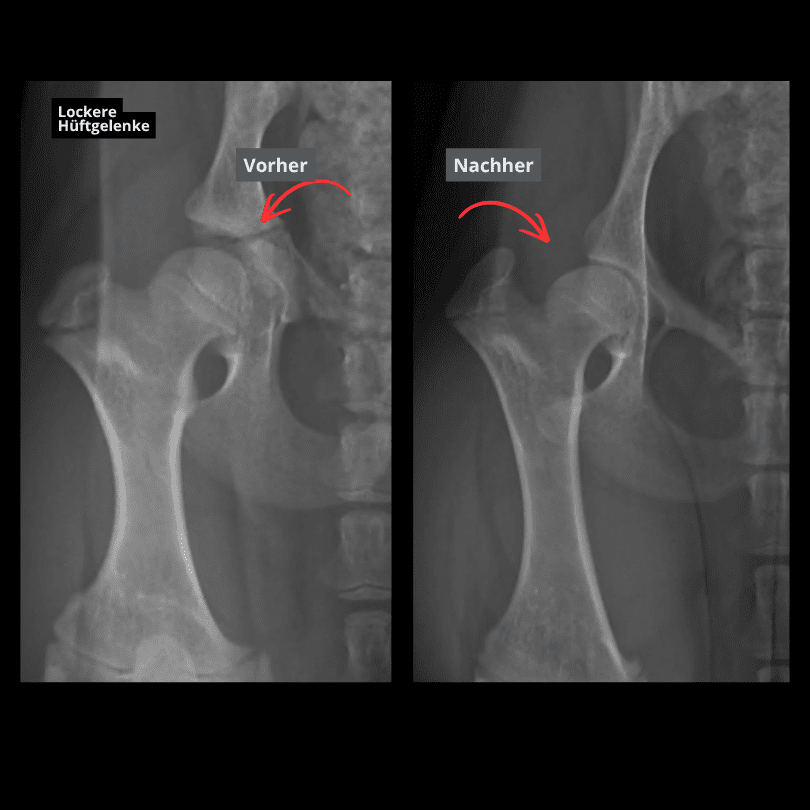
Hip dysplasia (HD) is one of the most common orthopaedic conditions in dogs. It involves abnormal development of the hip joint with insufficient coverage of the femoral head.
Special examination techniques are used in early diagnostics, e.g.:
- clinical stability tests (Ortolani test)
- growth and development assessment
- distraction view
- hip arthroscopy
The earlier laxity is detected, the better the treatment options—especially during growth.
Shoulder joint
In the shoulder, young dogs may develop osteochondrosis dissecans (OCD) or other developmental disorders, among other conditions.
Early signs include:
- intermittent lameness
- pain on extension or flexion
- reluctance to bear weight
X-rays and CT can detect changes early and, if required, treat them minimally invasively (e.g. arthroscopically). For larger lesions, surgical planning with cartilage-replacement procedures (resurfacing) is also possible.
Juvenile pubic symphysiodesis (JPS)
Juvenile pubic symphysiodesis (JPS) is a minimally invasive surgical procedure that can be performed only in early puppyhood.
The aim of the procedure is to improve coverage of the hip joint through targeted guidance of pelvic growth, thereby reducing pain and the development of osteoarthritis.
Key aspects of JPS:
- Performed only within a very early time window (usually between the 16th and 20th week of life)
- A prerequisite is early diagnosis of hip joint laxity, e.g. by X-ray and determining the distraction index (PennHIP method)
- The procedure is comparatively gentle
- The aim is to prevent severe HD progression
Timely examination of at-risk patients is therefore crucial in order to be able to use this treatment option.
Aim of early diagnosis
- Avoiding or reducing later osteoarthritis
- Improving quality of life
- Reducing invasive follow-up surgeries in adulthood
- Individual treatment planning during growth
Early diagnosis is therefore an important component of modern orthopaedic surgery in young animals.